The Career Iceberg
Why Purpose Is Five Things, Not One
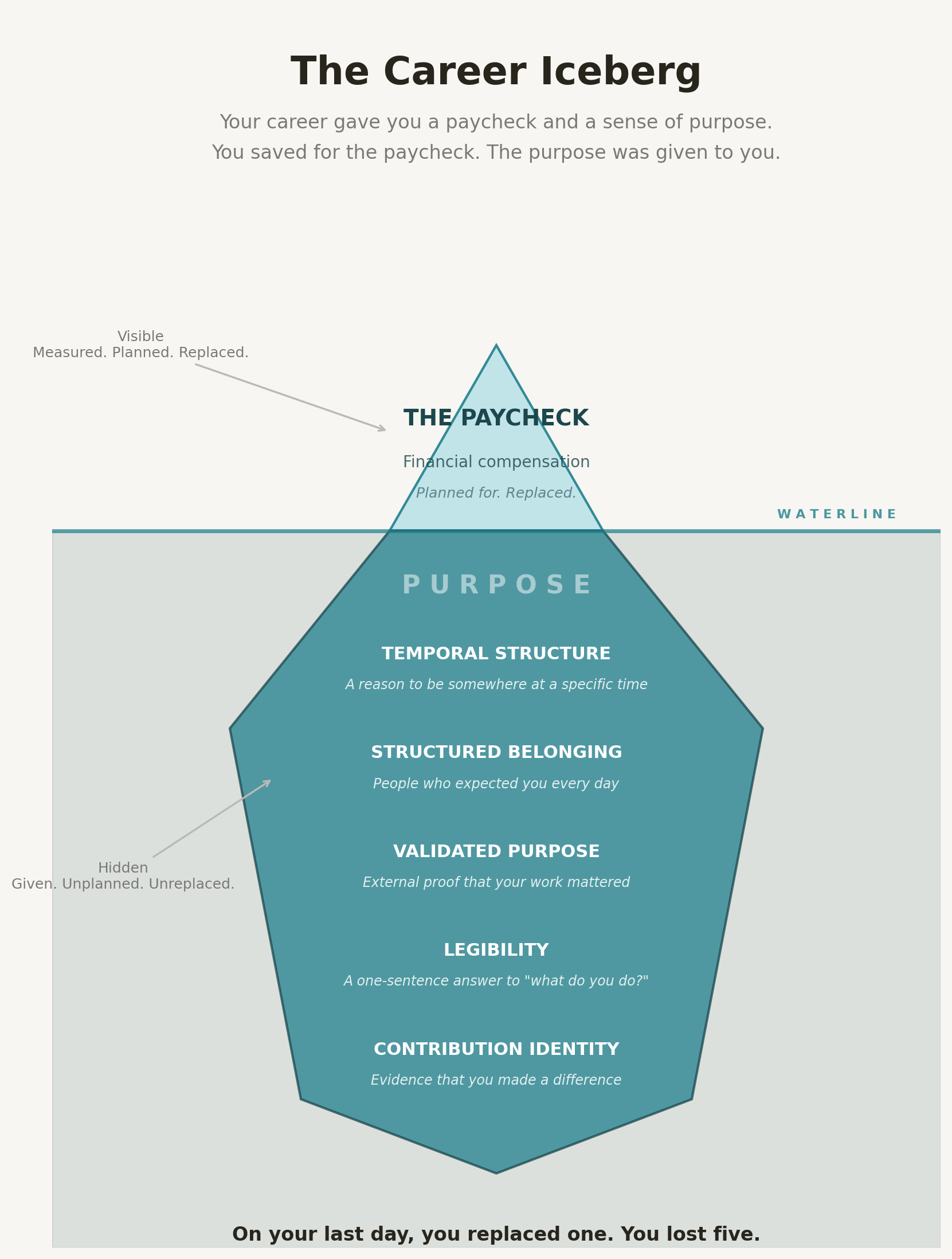
Every time I look at the data from the TRS assessment, one dimension sits at the bottom. Not close to the bottom — consistently, reliably, structurally at the bottom.
Purpose.
It’s not surprising, in hindsight. But the reason why it scores so low is worth understanding carefully, because it points to something most people get fundamentally wrong about this transition. The problem isn’t that people lack purpose. The problem is that they think purpose is one thing to find, when it was always five things being handed to them.
That’s the Career Iceberg. You saw the part above the waterline — the paycheck. You planned for it, replaced it, optimized it. Below the waterline was everything else your career was quietly providing. You never built it. You never maintained it. You never thought about its absence. And when the career ended, five invisible psychological needs surfaced all at once, and you had no plan.
What You Planned For, and What You Didn’t
Let’s be precise about what a career actually delivers.
The obvious part: income. You replaced it. Or you’re in the process of replacing it. Decades of saving, investing, optimizing a withdrawal strategy. The entire financial planning industry exists to help you replace that one thing. And in that sense, most of the people I talk to have done the work. The financial plan is solid.
What the financial plan doesn’t touch is the other half of the value proposition your career was delivering. For 30 or 40 years, your career wasn’t just a source of income. It was a bundled service. Five things, wrapped together, delivered daily, automatically, without you ever having to think about any of them.
When the career ends, the bundle disappears. All five things, simultaneously, on the same day.
This is why Purpose scores lowest. It’s not that people are purposeless. It’s that they never had to build purpose from scratch, because their career was doing it for them. They outsourced it completely and didn’t know they had.
The Five Things Inside the Bundle
Here’s what I mean when I say purpose is five things.
Temporal Structure. Your career gave you a reason to be somewhere at a specific time. Monday through Friday. The 9 a.m. standup. The monthly business review. The project deadline that made Thursday feel different from Wednesday. Work gave you a skeleton of time — a scaffold on which your days were organized. Without it, time becomes formless. Not in a pleasant, open-sky way. In a disorienting, days-blurring-together way. Three months into retirement, people start saying things like “I don’t know where the time goes” and “Tuesday feels exactly like Saturday.” That’s not a productivity problem. That’s temporal structure collapse. The scaffold is gone and nothing replaced it.
Structured Belonging. Work gave you people who expected you. The standup where your absence would be noticed. The Slack channel that lit up with your name. The lunch group that saved a seat. These weren’t friendships you chose — they were relationships created by proximity, by forced daily contact, by shared context. But that’s actually how most human connection forms: not through deliberate friendship-building, but through being in the same place, at the same time, repeatedly. Robin Dunbar, the evolutionary psychologist whose research mapped how human social networks are built and maintained, has shown that even close friendships decay fast — within about six months — when the shared context that sustained them disappears. Work didn’t just give you colleagues. It gave you the infrastructure that kept those relationships alive. When the job ends, the infrastructure goes with it.
Validated Purpose. This one is subtle but it may be the most important. Every day you worked, external systems were telling you that your effort mattered. The company paid you — that’s the market saying your work has value. Your manager reviewed your performance — that’s an institution confirming your contribution. Your customers responded, your projects shipped, your quarterly results were real. Society had a category for you. There was continuous, low-level external validation flowing in your direction, evidence that what you were doing was worth doing. In retirement, that flow stops. Completely. And in its absence, a question that almost never came up during a career starts whispering: does what I do matter? There’s no quarterly review in retirement. No paycheck confirming the answer is yes.
Legibility. You’re at a dinner party. Someone asks what you do. “I’m the Director of Operations at Northbridge.” Done. That sentence told a stranger everything they needed to sort you socially — your status, your expertise, your approximate place in the economic order. It gave you, and them, a transaction that felt easy. Legibility is social shorthand. It tells people how to categorize you, which tells you how to present yourself. In retirement, that sentence is gone and nothing replaces it. “I’m retired” is a status, not an identity. “I used to be at Dell” is a past tense that generates a kind of sympathetic ambiguity. Many people in retirement report that the dinner party question — a question they never once struggled with during their career — suddenly feels like a trap. Because they don’t know the answer anymore, and they don’t know why it’s so hard.
Contribution Identity. Separate from validation (which is external confirmation) is the ongoing evidence that you specifically make a difference. Promotions said you were exceptional. The team that needed you to close the deal. The client who asked for you by name. Recognition, results, the sense that your presence changed outcomes. This is contribution identity — a continuous feedback loop that confirmed, daily or weekly, that your participation mattered and wasn’t interchangeable. It’s the thing high performers often describe as what they miss most. Not the money. Not even the status. The sense that something is better because they did it. Remove it, and there’s silence. What you do today doesn’t have a visible outcome tomorrow. Nothing pings back.
This Has a Name, and It Has Data Behind It
Marie Jahoda identified this bundle in 1982. She was studying unemployment — specifically, why losing a job is psychologically devastating even after you control for the financial loss. Her insight was that employment provides a manifest function (income) and five latent functions: time structure, social contact, collective purpose, status, and activity. The latent functions are the psychological paycheck. And people who lose their jobs lose both paychecks simultaneously.
In 2023, a team of researchers ran a meta-analysis that tested Jahoda’s model across 106 studies and more than 48,000 people. The results confirmed every piece of it: each latent function independently predicts mental health. You can’t compensate for a deficit in one by overinvesting in another. They’re not interchangeable.
But here’s the finding that stops me every time I read it: retirees were nearly as deprived of these latent functions as people who lost their jobs involuntarily. The effect size for retirees compared to employed people was d=0.70. The effect size for unemployed people compared to employed people was d=0.61. The retirees scored worse.
The one difference: retirees were fine financially. They replaced the manifest function — the paycheck. They did not replace the latent functions. The psychological paycheck was not replaced. Nobody told them to replace it. Nobody gave them a plan. Nobody built an industry around it.
Self-Determination Theory, developed by Deci and Ryan at the University of Rochester, converges on the same conclusion from a different direction. Their foundational research identifies three basic psychological needs — autonomy, competence, and relatedness — as non-compensatory. That last word is important. Non-compensatory means you cannot make up for a deficit in one by overinvesting in another. If your Relatedness need is severely unmet, adding more Competence activities won’t fix it. Each need must be addressed on its own terms.
The five rafters of purpose map directly to these SDT needs. Structured Belonging is Relatedness. Contribution Identity and Legibility are Competence. Externally Validated Purpose draws on both Competence and Relatedness. Temporal Structure is, paradoxically, Autonomy — because when there’s too much unstructured autonomy, it becomes paralyzing rather than liberating.
What this means practically: you can’t zero out one rafter and compensate with another. You can’t build extraordinary Temporal Structure and expect that to fix a Contribution Identity deficit. Each rafter has to be rebuilt independently.
If the framework above is resonating — if you recognize the five rafters and can already feel which ones are weakest — the Purpose dimension of my readiness assessment is built to surface exactly this. It’s part of a free 20-minute conversation across all six dimensions. Take the Retirement Readiness Assessment.
The Roof and Its Rafters
In the TRS framework, Purpose sits at the top. It’s the roof — what makes the retirement structure worth living in. The foundation is Health and Wealth. The walls are People and Place. The roof is Purpose.
And a roof needs rafters.
While you were working, your career was the rafter system. Not one rafter — five. Each one load-bearing. Each one invisible, because when something never fails, you stop noticing it exists. The standup provided Temporal Structure. The team provided Structured Belonging. The quarterly review provided Validated Purpose. The title provided Legibility. The results and recognition provided Contribution Identity. Five rafters. All of them structural. None of them visible until they start crumbling.
When the career ends, you see the rafters for the first time. And they’re crumbling. You can have a perfect foundation — excellent health, strong finances — and solid walls — a good marriage, a community you like — and still feel profoundly unmoored if the roof is collapsing. A structure without a roof exposes everything underneath to the elements. That’s what low Purpose feels like, even when every other dimension is solid.
The research is unambiguous about what’s at stake here. A JAMA Network Open study of nearly 7,000 adults over 50 found that people with the lowest sense of purpose had 2.43 times the all-cause mortality risk of those with the highest — and 2.66 times the heart and circulatory mortality risk. Research from Rush University found that purpose delayed Alzheimer’s onset by approximately six years (high-purpose adults developed it around age 95 versus age 89 for low-purpose adults). Purpose in life declines three years before the onset of mild cognitive impairment — it’s a leading indicator, not a trailing one.
This isn’t soft. This is the ApoB of retirement — the single most predictive variable for what your next chapter actually looks like. And it’s the dimension almost no one plans for.
What Rebuilding Actually Looks Like
I want to be precise about this, because the framing matters.
The people who score well on Purpose in the TRS assessment aren’t the ones who had a profound epiphany about their life’s meaning. They’re not the ones who sat quietly on a mountaintop until clarity arrived. They’re the ones who, often without any theoretical framework to guide them, rebuilt the five rafters independently. They didn’t find their purpose. They rebuilt the infrastructure that purpose depends on.
That distinction is everything.
Temporal Structure is the most mechanical rafter to rebuild, and often the highest-leverage starting point. A morning routine. A weekly commitment that’s non-negotiable. A project with real deadlines. The goal isn’t to fill time — it’s to give time shape. Tuesday needs to feel different from Saturday. Something has to make Wednesday morning have a specific character. The discipline isn’t punishing. It turns out most people flourish under moderate structure. They were getting it for decades and didn’t notice. Rebuilding it is often the thing that makes everything else feel more possible.
Structured Belonging is trickier because it requires other people and a recurring context. The key word is recurring. One-off events don’t build structured belonging. Showing up to the same place, with the same people, on the same schedule is what builds it. The board meeting you’re on. The volunteer shift every Tuesday morning. The golf group that goes out every Saturday. The weekly class that has the same cast of characters. This isn’t about finding a new best friend. It’s about recreating the infrastructure of forced regular proximity, which is how most human connection actually forms, whether we like to admit it or not.
Validated Purpose is the rafter that requires an audience. The activity has to produce something that someone else receives and responds to. Mentoring works because the mentee’s progress is visible and they tell you it mattered. Teaching works for the same reason. Writing and publishing works — the response, even from a handful of people, is external validation. Advisory roles work when the board actually uses your input. The key is feedback. Something you do has to close a loop with another person who says, in some form, “that mattered.” Without that loop, this rafter stays empty.
Legibility is the dinner party question, but it’s really a deeper question about identity. “What do you do?” is asking where you fit in the social order. In retirement, you’re building a new answer — and it needs to be one you can say without flinching or immediately adding “I used to be at…” The new answer doesn’t reference a former title. It’s present tense. It’s about what you’re doing now, what you’re building, what you care about. Getting there takes time and iteration. It’s not found — it’s drafted, tested, and refined through actual experience. Most people end up with an answer that surprises them.
Contribution Identity is rebuilt through evidence of impact — any activity that generates proof that your participation changed something. Volunteering where the outcome is visible. Building something in your community. Serving on a committee where your expertise is genuinely needed. The feedback loop that work provided automatically has to be reconstructed deliberately. Something you do has to leave a mark that you can see.
The way to approach this is as experiments, not commitments. Small, time-boxed, low-stakes. A two-hour volunteer shift. One mentoring session. A morning routine you try for four weeks. The goal at the start isn’t to find the answer — it’s to generate signal about which rafters feel most depleted and which activities start to fill them. The diagnosis tells you which rafter is weakest. Start there.
What you’re not doing is “finding your purpose.” That framing sets up a search for one grand answer, as if purpose is an object you locate and then possess. It isn’t. It’s a structure. And structures are built, not found.
The Shape of Your Iceberg
The career iceberg pattern is nearly universal among the people we see in the TRS assessment. The visible part — the paycheck, the financial plan, the retirement account — is what everyone thought about, planned for, and optimized. The hidden part — five psychological needs silently embedded in the role for decades — went completely unexamined.
What’s not universal is the shape below the waterline. Some people exit careers with strong Temporal Structure already beginning to rebuild — they had hobbies, they had routines outside of work, they had a project waiting. Others are drowning in unstructured time from day one. Some people have strong social networks that survived career-dependence and can provide Structured Belonging relatively quickly. Others have nothing but work colleagues, and Dunbar’s decay is already happening.
The TRS assessment surfaces your Purpose score and, through the evidence it collects, can identify which of the five rafters are most depleted. That’s the starting point — not “your purpose score is low, work on it,” but “here’s specifically which of the five things your career was giving you are most missing, and here’s where to start rebuilding.”
The shape of your iceberg is unique. But the pattern — one piece visible and planned for, five pieces hidden and unplanned — is nearly universal.
Your career gave you a paycheck and a purpose. You planned for the paycheck. The purpose was given to you. It’s time to start building it yourself.
Build your five rafters
Purpose is one of six dimensions in my retirement readiness assessment. Find out which of your five rafters are most depleted — and where to start rebuilding.
Take the Retirement Readiness Assessment
A 20-minute AI-guided conversation. Six dimensions scored. A personalized Retirement Blueprint with your 90-day action plan.
“Absolutely brilliant — mega quick and insightful, gave me a great assessment and some real tangible things to address.”
Greg
Retiring within 3 years
“I genuinely think everyone thinking about or in retirement already should do this.”
Barry
Recently retired
“It's a bit cathartic to go through that structured thought process — and the results are spot-on.”
Michael
5+ years from retirement
Continue reading
Retirement Identity Loss: Who Am I After I Stop Working?
Your title was never just a title. How to rebuild identity when the career ends.
PurposePurpose Is Not a Statement — It Is a Developmental State
Why the “find your purpose” framing fails — and what to do instead.
PassionRetirement Boredom: How to Find Passion After a 30-Year Career
When leisure isn’t enough — and how to find what actually lights you up.
Statistics & Research Citations
- Marie Jahoda, Employment and Unemployment: A Social-Psychological Analysis (1982): Identified five “latent functions” of employment beyond income — time structure, social contact, collective purpose, status/identity, and regular activity. Each independently predicts mental health.
- 2023 meta-analysis (106 studies, 48,000+ participants): Confirmed Jahoda’s model. Effect size for retirees vs. employed (d=0.70) exceeded that of unemployed vs. employed (d=0.61). Each latent function is non-compensatory — you cannot offset a deficit in one by overinvesting in another. pubmed.ncbi.nlm.nih.gov
- Self-Determination Theory (Deci & Ryan, University of Rochester): Three universal psychological needs — Autonomy, Competence, Relatedness — each independently predicts wellbeing and each is non-compensatory. selfdeterminationtheory.org
- JAMA Network Open: Study of ~7,000 adults over 50; those with the lowest sense of purpose had 2.43× all-cause mortality risk and 2.66× cardiovascular mortality risk compared to those with the highest sense of purpose. jamanetwork.com
- Rush University Memory and Aging Project: High-purpose adults developed Alzheimer’s at approximately age 95 vs. age 89 for low-purpose adults — a ~6-year difference. Purpose in life declines measurably 3 years before onset of mild cognitive impairment (leading indicator).
- TRS Assessment data (April 2026, n=144; 220 total completers): Purpose averages 6.7/10, the lowest of the six dimensions and the only one significantly below the 7.3-7.4 cluster of the other five. Purpose is the lowest-scoring dimension for 30% of users — the highest “lowest for” rate of any dimension.
Dennis Hoffman has been building, advising, and running technology businesses for 40 years — from Avid Technology to a startup he founded to a venture capital EIR to 22 years at EMC and Dell Technologies, where he ran corporate strategy and a business unit. He has an MBA from Harvard, taught at MIT Sloan, and is now building The Retirement Strategy. He also writes a weekly Monday essay at juststarted.pub about what it actually looks like to build with AI tools after a long career in something else. Connect with him on LinkedIn.